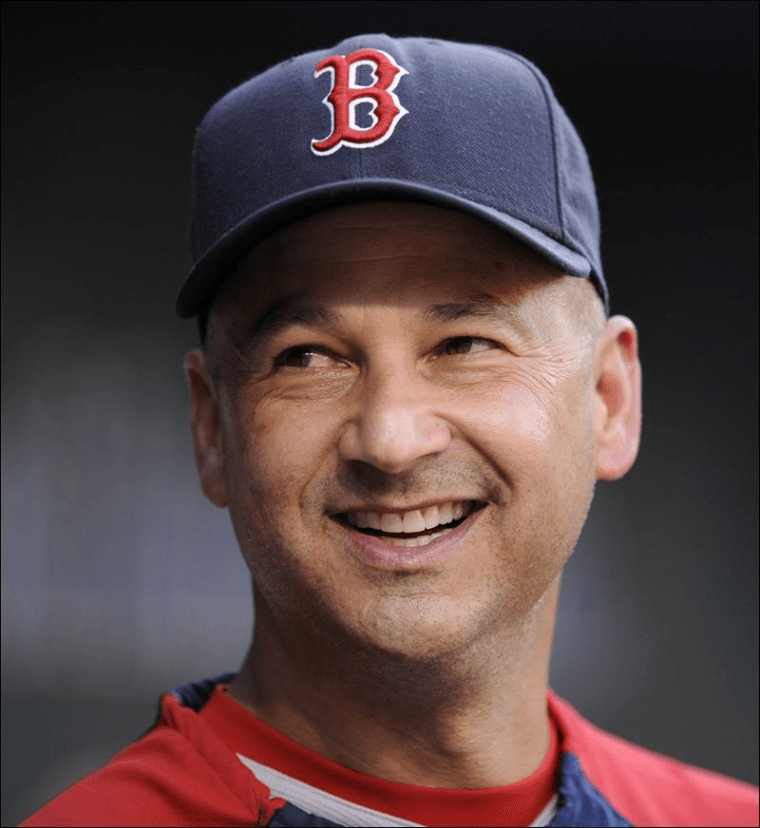
Twenty years ago, something truly unbelievable happened.
The Boston Red Sox, a self-described “bunch of idiots,” did something that hadn’t happened in my father’s lifetime, or my grandfather’s lifetime.
There were times I didn’t think it would happen in my lifetime.
They broke an 86-year curse, and won the World Series.
This is the second in a series of articles about the people who made this miracle happen.
Not necessarily in order of importance. In chronological order. In whatever order makes sense to me.
I’ll try to publish one article each week of this 2024 season. [Editor’s Note: Ha!}
And just remember: Every single word of this is true.
Previous article: Peter Gammons
Sunday, April 4, 2004
Opening Day in Baltimore
The Sox, behind Pedro Martinez, lost to the Orioles, 7-2.
But when the media entered the locker room to grill him about the loss – Pedro wasn’t there.
Oh oh.
We still had the awful taste in our mouth from the 2003 ALCS collapse against the Yankees.
When last we saw Pedro, he was giving up an 8th inning lead.
This isn’t exactly the fresh start that we were looking for.
After the game, new manager Terry Francona was amazingly calm. Forgiving.
“In fairness to him, and everybody else, that wasn’t conveyed correctly on my part,” he told the stunned reporters. “I take responsibility for that.”
What?
Everybody knows that ballplayers don’t leave the ballpark early; every man stays there until after the game. No matter how bad it was.
Here we go again, was the overall reaction on sports talk radio.
Same old Red Sox.
But here’s what we didn’t know.
The next day, Francona went looking for his sensitive, high-maintenance pitcher.
Pedro was with trainer Chris Correnti, who warned Terry, “Careful, he’s about to blow.”
“Fuck that,” Tito snapped back. “Where is he?”
He found Pedro and brought him into his office, where he sat stone-faced and silent as he listened to his new manager.
“I just wanted him to know how things should be,” he later said.
“I wanted him to understand that I’d take a bullet for somebody. But you got to do things right.”
[This story, and several others noted in this article, come from the revealing book Francona: The Red Sox Years, co-authored by Francona and Boston Globe scribe Dan Shaughnessy. If you’re a fan of Francona, or the Red Sox (or Shaughnessy) it’s a great read.]
* * *
The 2004 Red Sox were rightfully known as The Idiots – in their own words.
But even so, I don’t think we fully appreciate just how insane they were.
Just consider some of the characters who were parading through the locker room:
- Pedro Martinez, with his diva attitude, and his midget guest/mascot, Nelson De La Rosa
- Johnny Damon, with his marquee idol hair, and his pre-game naked pull-ups
- Curt Schilling, with his penchant for saying whatever came to mind to any available media member, including his right-wing preachings and ramblings
(Then there were the wives, with the whole Shonda Schilling vs Michelle Damon “scarf feud”.) - Kevin Millar, with his goofy “Cowboy Up” cheerleading, and his Jack Daniels shots before games
- Bronson Arroyo, with his cornrows and his acoustic guitar
- Manny Ramirez, with his imaginary hamstring pulls, and his… just being Manny
The amazing thing is, they still are just as insane, twenty years later.
That was clear from the reunion of this lovable band of idiots on Opening Day this year.
During the game, Johnny Damon made appearances on both the television and radio broadcasts.
In each one, he made it a point to reassure the audience that he is still in great shape, with his “fine calves, and that sweet ass.”
There was only one man who could steer this cast of characters.
Terry “Tito” Francona.
* * *
It’s funny – we look back at seasons like 2004 and think of it fondly as “that magical season.”
Oh, it was – 2004 was a once-in-a-lifetime trip.
But hindsight is soft and fuzzy.
We forget that the Sox actually finished behind the Yankees in the AL East, making the playoffs as the sole Wild Card team. (Back then, there was just one Wild Card team).
Sure, the Red Sox won 98 games. But there were 64 losses – and some of them hurt.
Take the Home Opener, a 10-5 drubbing to Toronto.
It got so bad that Dave McCarty (first baseman/outfielder) pitched the 9th inning.
What the hell is he doing, bringing in a position player to pitch? In the Home Opener!
Still, they ended the month of April at 15-6, two-and-a-half games up in the AL East.
But they started May by losing five in a row. The lead dwindled down to nothing.
Time for a meeting.
Except, it wasn’t throwing chairs and curse words around. (Although Tito can curse with the best of ‘em.)
Instead, it was Tito telling them, “Guys, I just want to let you know that we’re good and we’re going to be good.”
[It’s not that far from Ted Lasso telling Jamie Tartt, “Your talent is one-in-a-million.”]
“We’re in it for the long haul. I’m not panicked,” he assured them. “Just go about your business and pay attention to detail and we’ll be okay. I love every one of you guys. You’re going to be fine, trust me.”
“I love every one of you guys”???
What kind of a fruitcake is this guy?
Twenty years and four championships later, it’s hard to remember: These guys had plenty of demons hanging around in the clubhouse.
For years now, players who weren’t around in 1946, or 1967, or 1975, or 1978, or 1986 had to answer for Johnny Pesky, or Bill Lee, or Mike Torrez, or Bill Buckner.
Sometimes you need somebody to tell you: Forget about the past.
They won their next four games, and they went on a 15-8 run.
* * *
Tito started playing cards with the coaches and players on trips.
It brought the team together.
He later explained (to Dan Shaughnessy), “I’ve always contended that no one could be a good big league manager if he’s a shitty card player. It’s got all the things you need to do to manage. It’s the same mentality. You have to not be afraid, gamble a little bit, think quickly.”
Ortiz passed by the in-flight poker game one night, and called them “a bunch of pussies”.
But wouldn’t you know, he got into it, and shortly he was joined by Mark Bellhorn, then Johnny Damon.
“There would be a group of us playing, and another group standing over us screaming and yelling,” Tito said. “We’d have 12 or 13 guys standing around.”
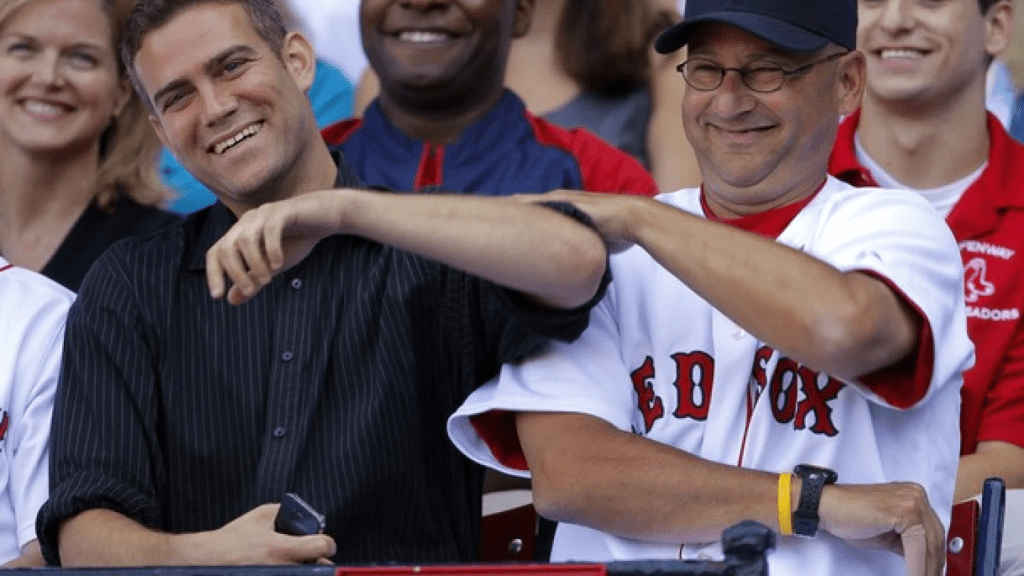
General Manager Theo Epstein hired Francona, and the two became good friends. He knew how important it was, what Tito was doing.
“One of Tito’s greatest strengths was to empower players and put them at ease and let them be themselves and feel great about themselves,” Theo told Shaughnessy.
“He created this atmosphere where you show up to the clubhouse and the outside world ceases to exist…. That 2004 team had some great camaraderie. They could go out and stand shoulder to shoulder, play hard together, then come in and laugh about it in the end.”
As Terry put it, “It’s amazing what you can tell someone at three in the morning on a plane when they’re playing cards that you could never say in the dugout during a game… I could say to David, ‘When you hit that pop-up down the left field line, if you had run harder, do you think you could have been at second?”
[Notice that he puts his lesson in the form of a question. Tito would never cop to using the Socratic Method – but he had the wisdom of Socrates.]
(Reuters)
Again, it wasn’t always smooth sailing.
Despite their May spurt, they went 43-43 from April 29 to August 6.
Tito, Theo, everybody knew it – something was just not right with this ballclub.
The heartbreaking part was, the weak link was their beloved shortstop. Nomar Garciaparra, fan favorite, surrogate son of Ted Williams.
When Tito took the job as manager before the 2004 season, he made a point of reaching out to every single one of the players. (Manny was the only one who didn’t return his calls.
He took particular care in talking with Nomar.
Nomar had been through a rough off-season. Remember, he was traded – essentially for Alex Rodriguez.
(Nomar was sent to the Chicago White Sox, for Magglio Ordonez, while Manny was shipped to the Texas Rangers for A-Rod.)
The trade was short-lived – the Sox wanted A-Rod to take a cut in salary; A-Rod agreed, but the MLBPA nixed it.
And Nomar was left with the knowledge that he was no longer wanted.
At the same time, he was dealing with an Achilles heel injury (which the team later sneakily claimed was due to extra-curricular activities with his soccer-playing wife, Mia Hamm).
He was hurt, physically and emotionally.
And so were the Red Sox. Their Achilles heel was defense, as Theo very delicately explained when he traded Nomar to the Cubs.
But suddenly, Tito could make late-inning defensive substitutions, inserting Orlando Cabrera and Doug Mientkiewicz – the pieces they got in return.
And guys like Pokey Reese, or Gabe Kapler, or Dave Roberts (acquired in another trade) gave him an element of speed.
After the trade, they went 40-15, including 21-7 in August.
They went to the playoffs. Where Terry Francona outmanaged three of the most revered managers in the game: Mike Scioscia, Joe Torre, and Tony La Russa.
They dispatched with the Angels in three games, a David Ortiz homer in the 9th inning waltzing them into a rematch with the Yankees in the ALCS.
Sometimes, it was the little things. Things that went unnoticed at the time.
In the midst of the most horrifying loss of all, the 19-8 pummeling in Game 3, he and Tim Wakefield made a subtle, but significant move.
Down 9-6 in the 4th inning, Francona called for Wakefield.
His bullpen was depleted – the Yankees had kicked around Bronson Arroyo, Ramiro Mendoza and Curtis Leskanic.
Wakefield had been a consistent starter throughout the year – but he was needed in a different role tonight.
Wakefield “took a bullet” for the team, as the saying goes.
He wasn’t any more successful at stopping the Yankees, but he labored for three more innings.
What he did was to give the bullpen a break. They proved to be ready for the rest of the series.
But what stuck with me was Francona’s demeanor the following day.
Before the game, he was asked about the mood in the locker room. “Oh, they’re fine,” he shook his head. “I don’t think those idiots even know they’re down 3-0. They have the same stupid music playing in there that they always do.”
They never lost again.
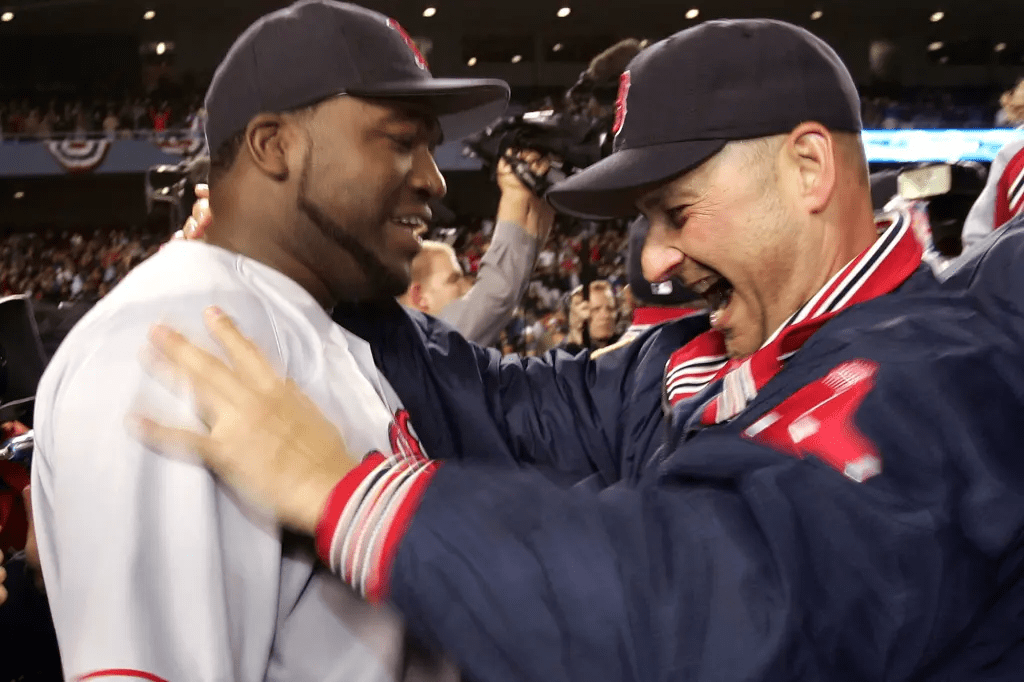
Four straight over the Yankees.
Four straight over the Cardinals.
First World Series in 86 years.
(Getty Images)
Back when Theo was deciding who would replace Grady Little, it looked like Bud Black had the inside track.
But once Bud heard that Terry was being interviewed, he withdrew his name, and stayed on as pitching coach of the Angels.
“It was a good situation with the Angels,” Tito told Shaughnessy. “But in my mind, part of the reason he took himself out of it was because the Red Sox called me.”
The final cut included Joe Maddon (Angels bench coach), Glenn Hoffman (Dodgers third base coach, former Red Sox utility man), and DeMarlo Hale (Rangers first base coach, with many years coaching in the Red Sox minor league system).
All good guys – but hard to imagine any of them navigating the various minefields as deftly as Tito did.
The thing that iced it for Theo was Francona’s preparation, his knowledge of in-game situations.
He literally grew up in major league clubhouses, with his father, the original Tito Francona, of the Cleveland Indians.
Tito regularly arrived at the ballpark at 12:30 for an 8:00 game.
“I know that sleep as I knew it is done,” he told reporters after that Opening Day loss in Baltimore.
“That’s just the way it goes. You guys may think I’m not looking too good right now, but wait until the end of the season.”
That dismissive, off-the-cuff joke told us everything we needed to know about Tito:
A. He was a baseball lifer. The clubhouse was his home.
B. He took his job seriously.
C. He did not take himself seriously.
It was easy to criticize Tito for his easy-going nature.
But you tell me: You think Dick Williams could’ve held it together with the characters that inhabited the zoo of the Red Sox locker room?
You think because Earl Weaver was a “tough guy” he could’ve got the most out of ‘em?
I could never understand blowhard managers and coaches who criticize their players in the media. (Look no further than Tito’s successor, Bobby Valentine.)
What good did that do, except to get your players angry?
Behind the scenes, in the locker room, Tito was as tough as anybody.
Want another example?
After Keith Foulke threw his arm off in the 2004 postseason, the Sox found themselves in need of a closer in 2005.
Curt Schilling offered up his services. But it didn’t go well, and he blew a few saves before the experiment ended.
While Schill was still trying to close, Johnny Damon took it upon himself to criticize the move, and Schilling in particular.
Damon’s sermon to the media was interrupted by a bellow from the manager’s office: “Hey dumbass! Get in here!”
Francona pulled him in, and explained – in private, but very explicitly – the folly in publicly criticizing another teammate.
The World Series sweep of the Cardinals proved to be validation of all of Tito’s preparation.
He and the coaching staff (and scouting staff) were ready for the St. Louis hitters and pitchers.
The Cardinals won 105 games in the regular season, but couldn’t manage a single win against the Red Sox.
Feared sluggers like Albert Pujols, Jim Edmunds, Edgar Renteria, and Scott Rolen went almost silent. After the wild 11-9 opening loss at Fenway, the Cards scored 2, then 1, then 0 runs in the next three games.
After that, and after the 2007 sweep of the Colorado Rockies, Tito had a little cache in town.
He’d still patiently answer every question on his Wednesday afternoon interviews on WEEI, the Boston Sports Talk station.
But it wasn’t until after 2007 that I heard him finally say. “You know guys, I hate to say it… But we have won a couple of World Series here, you know? I think we’re doing pretty good.”
November 29, 2011
A car pulls up in front of the home of Dan Shaughnessy, Boston Globe sports columnist.
Shaughnessy has been the hall monitor of Boston sports teams for more than forty years now, as well as a professional agitator.
Since he started covering the Sox in 1981 for the Globe, he has made it his job to hold the teams accountable, and to call them on the carpet when he deems them out of line.
Shaughnessy comes out of his house and gets into Tito Francona’s car
It’s a strange pair of road trip buddies.
Shaughnessy tangled often with Tito over the years.
As they pull away, Tito quips, “Our first stop is going to be someplace where we can get these windows tinted so nobody’ll see me driving you around.”
Tito has joined forces with Shaughnessy to set the record straight, and co-write the revealing tell-all Francona: The Red Sox Years.
The books reads like a bloodletting, for Francona, and for Theo Epstein – and probably for Shaughnessy, to a certain degree.
Dan and Tito sat for days and talked about his eight years with the Sox.
Theo did, too, “owing to his enduring respect for Terry Francona,” as Shaughnessy wrote.
The Red Sox had fired Terry Francona on September 30, 2011, after the disastrous collapse of the “chicken and beer” team, the team that fell apart and blew a 9-game lead, falling out of the playoffs on the final night of the season.
But it wasn’t enough to fire Tito – the Boston Globe ran a lengthy, titillating, front-page story by Bob Hohler, revealing private details about Tito.
It was National Enquirer-level stuff.
The story had no business being in a newspaper, other than to “justify” the firing of the revered manager.
He had developed an addiction to painkillers, the story said.
His long-term marriage to his college sweetheart, Jacquie, was falling apart.
He spent nights sleeping on the couch in the manager’s office at Fenway, or in a Kenmore Square hotel.
The Red Sox owners never admitted to feeding the story to Hohler.
But they never revealed who did feed it to him.
All three of the major owners had the capacity to do it.
Tom Werner was certainly media-savvy enough.
John Henry was certainly image-conscious enough.
Larry Lucchino, God knows, was a bitter, vindictive man, who always tried to come out on top.
I haven’t been able to figure it out.
But mainly: How does Bob Hohler sleep at night?
How can he still call himself a journalist, after carrying out somebody’s personal agenda like that?
* * *
If pressed, I will say that Tito is probably THE most important reason for the Miracle of 2004, for the success of this band of idiots.
My short list, off the top of my head:
1. Tito
2. Theo
3. Ortiz
4. Damon
5. Schilling
6. Pedro
… Who knows? It’s impossible to choose. There are so many of them.
You could justifiably say, if you remove any one of these guys – not to mention Millar, Varitek, Mueller, Foulke – they don’t win it.
I’m ok with my top three, though.
And I have no doubt about the first choice.
There’s no way this happens without Tito.
He’s the guy who allowed The Idiots to be themselves.
He’s the guy who let them know, it’s ok to not take things too seriously.
He’s the guy who told them, “Don’t worry about what happened here before us. Just do what you do.”
He’s the guy who did something no other manager did in my lifetime:
He led the Red Sox to a World Series victory.
Twice, actually.
 Daddy Gibs